Size switchable nanomodulator achieving ratio-precise dual-drug codelivery for synergistic glutamine metabolism modulation in pancreatic cancer
Time:2026/7/13 23:34:49 Views:175
Recently, we have reported a multifunctional co-delivery system
with size-switchable and enhanced stroma-penetrating capacities. This delivery
system can deliver distinct glutamine metabolic regulators deep into pancreatic
ductal adenocarcinoma (PDAC) lesions at a precisely predefined molar ratio, and
exert synergistic tumor-suppressive effects via multi-targeted metabolism modulation
and immune activation. The relevant research, entitled Size switchable
nanomodulator achieving ratio-precise dual-drug codelivery for synergistic
glutamine metabolism modulation in pancreatic cancer has been published in Biomaterials.
Driven by persistent nutrient deprivation within the tumor
microenvironment (TME) and nearly universal KRAS mutations, PDAC cells exhibit
profound glutamine addiction, which directly underpins its malignant phenotypes
and inherent clinical refractoriness.
PDAC cells
coordinately upregulate multiple glutamine transporters, including SLC38A2 and
SLC7A5, to rapidly uptake and deplete glutamine from TME. Meanwhile, the highly
expressed glutaminase (GLS) catalyzes intracellular glutaminolysis, converting
the imported glutamine into readily utilizable proximal metabolites ADDIN EN.CITE ADDIN EN.CITE.DATA . This concurrent
high expression of transporters and metabolic enzymes forms a glutamine
addiction axis characterized by unrestrained uptake and rapid metabolic
utilization, which not only maintains intracellular redox homeostasis and the
balance of material and energy metabolism, but also accelerates the malignant
progression of PDAC. Meanwhile, excessive glutamine consumption by PDAC cells
markedly depletes glutamine availability within the TME, inducing metabolic
stress in fibroblasts and immune cells and reprogramming them toward
pro-tumorigenic phenotypes This process accelerates extracellular matrix (ECM)
deposition and suppresses antitumor immunity, ultimately forming a
treatment-resistant barrier characterized by both physical obstruction and immunosuppression.
Accordingly, targeting the aberrant glutamine metabolism represents a rational
therapeutic entry point. However, due to the high metabolic plasticity of tumor
cells and the metabolic convergence in normal tissues, GLS inhibitors such as 6-diazo-5-oxo-L-norleucine
(DON) have shown limited in vivo efficacy and unacceptable
systemic toxicity, severely restricting their clinical translation. These
failures indicate that unrestricted single-target metabolism modulation is
insufficient to effectively remodel the metabolic landscape of PDAC, whereas
precision modulation of the uptake-utilization axis throughout multi-target
synergy is required to enhance efficacy while minimizing systemic toxicity.
Extensive studies
have demonstrated that by screening the optimal combination ratio, rational
drug combination can achieve synergistic therapeutic effects. Unfortunately,
mismatched pharmacokinetics among different small-molecule drugs pose an
intrinsic challenge to achieving synergistic metabolism modulation in vivo, as it remains challenging to
deliver these agents to their targets at a predefined ratio. In this context,
nanomedicine-based drug delivery systems have demonstrated unique advantages in
synchronizing drug pharmacokinetics and enabling ratio-precise multi-drug codelivery,
thereby providing critical technical support for multi-target metabolism modulation.
Nevertheless, excessive ECM deposition driven by glutamine addiction creates a
highly dense physical barrier that severely restricts nanocarrier penetration
and drug accumulation within tumor tissues. To overcome this bottleneck, a
variety of PDAC-tailored delivery systems have recently been developed,
commonly incorporating TME-responsive size-switchable properties. Such designs
maintain systemic circulation stability while enabling size reduction within
the PDAC TME, thereby facilitating deep ECM penetration and efficient malignant
cell-targeted drug delivery.
Based on these
considerations, we propose and validate the central hypothesis that a size-switchable,
ECM-penetrating nanocarrier can overcome PDAC physical barriers to achieve ratio-precise
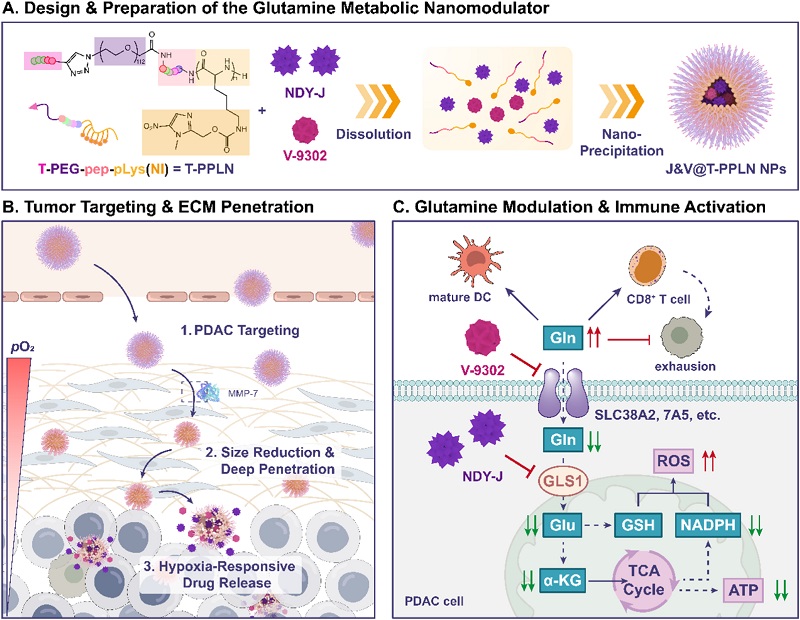
dual-drug codelivery and synergistic modulation of glutamine metabolism To this
end, we engineered a PDAC-targeted, matrix metalloproteinase (MMP)-cleavable
multifunctional amphiphilic polymer T-PPLN and precisely co-encapsulated the
GLS inhibitor NDY-J and the transporter inhibitor V-9302 at an optimized ratio,
constructing a size-switchable metabolic nanomodulator J&V@T-PPLN NPs.
Following intravenous administration, the nanomodulator preferentially
accumulated within collagen-rich PDAC ECM; upon entry into the TME, elevated
MMP-7 activity triggered de-PEGylation of J&V@T-PPLN NPs, releasing smaller
drug-loaded metabolic nanomodulators that enabled deep ECM
penetration. Ultimately, responsive drug release synchronously blocked
glutamine uptake and utilization in PDAC cells, inducing upstream-downstream
synergistic metabolic disruption. Both in
vitro and in vivo studies
demonstrated that this nanomodulator achieves ratio-precise codelivery of two
metabolic inhibitors based on combination index optimization, maximizing
therapeutic efficacy while minimizing nonspecific tissue exposure and ECM
entrapment. Collectively, this strategy synergistically induces metabolism
modulation, tumor suppression and immune reactivation, establishing a new
paradigm for precision metabolism modulating therapy in PDAC.
PhD candidate Hongrui Fan serves as the first author of this
manuscript, and Prof. Chen Jiang is the corresponding author. This work was financially
supported by the
National Natural Science Foundation of China, Shanghai Municipal Science and
Technology Major Project, ZJ Lab, Shanghai Center for Brain Science and
Brain-Inspired Technology, and the Open Grant from the Pingyuan Laboratory.
Link: https://www.sciencedirect.com/science/article/pii/S0142961226004308?via%3Dihub

