AI-Optimized 3D-Printed Dual-Layer Implant: Resolving Chemo-Immunotherapy Sequential Administration Dilemma for Colorectal Cancer Peritoneal Metastasis.
Time:2026/7/13 23:08:52 Views:166
Colorectal
cancer peritoneal metastasis (CCPM) poses a significant clinical challenge due
to the widespread dissemination of lesions, the difficulty of local treatment
and a markedly immunosuppressive microenvironment. Although conventional
hyperthermic intraperitoneal chemotherapy (HIPEC) allows for local drug
delivery, it is limited by a short drug retention time, a lack of targeting,
the inability to achieve sequential treatment and significant adverse effects.
To address this challenge, this study innovatively combines artificial
intelligence (AI) with 3D printing technology to develop an AI-optimised
dual-layer drug implant (LEH@OG), enabling the precise, sequenced release of
chemotherapeutic and immunotherapeutic agents, thereby providing a novel approach
to personalised treatment for colorectal cancer with peritoneal metastasis. The
findings were published in the internationally renowned journal “Advanced
Materials” under the title “AI-Optimised 3D-Printed Dual-Layer Implant:
Resolving the Dilemma of Sequential Administration of Chemotherapy and
Immunotherapy for Peritoneal Metastases in Colorectal Cancer”.
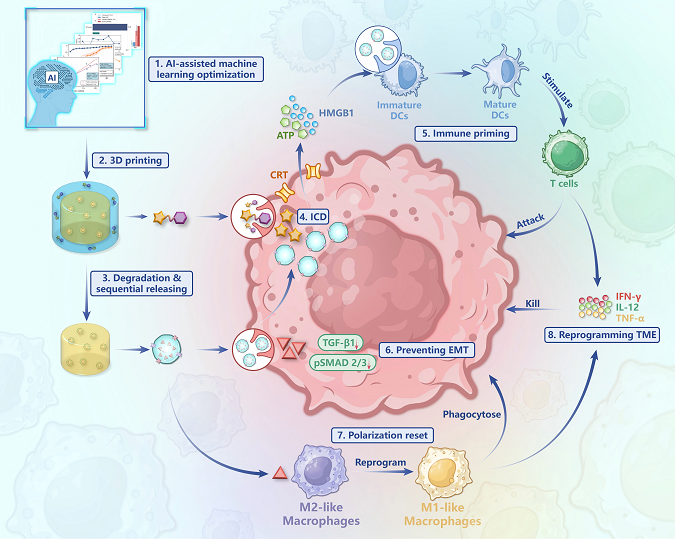
Recent
research has shown that chemotherapy-induced immunogenic cell death (ICD)
releases tumour antigens and damage-associated molecular patterns (DAMPs),
thereby initiating immune sensitisation; Subsequent immunotherapy can further
lift immune suppression and generate lasting immune memory, with the two
approaches exhibiting significant synergistic effects. However, existing
clinical administration methods struggle to achieve the ideal sequence of
chemotherapy followed by immunotherapy, thereby limiting the efficacy of this
synergistic treatment. Furthermore, the dispersed nature of peritoneal
metastases and the complex intraperitoneal environment pose significant
challenges to sustained, localised and precise drug delivery.
To
address these issues, this study developed an AI-assisted, 3D-printed bilayer
implant, LEH@OG. This implant features an outer shell constructed from
photo-crosslinked GelMA, encapsulating a thermosensitive hydrogel core. An
artificial intelligence model was used to predict and optimise the shell
thickness, material concentration and structural parameters, enabling the outer
layer to degrade precisely after approximately 48 hours and release the core,
thereby achieving precise time-controlled drug delivery.
Tang
Wei-yi, a Master’s student in our research group, is the first author of the
paper; Associate Professor Sun Tao is the corresponding author; and Professor
Jiang Chen and Professor Wang Jiaqi from the University of Hong Kong are
co-corresponding authors. This research was supported by the National Natural
Science Foundation of China, the Shanghai Major Science and Technology Special
Project, open funding from the Pingyuan Laboratory, and the Zhangjiang
Laboratory.
Original article: https://advanced.onlinelibrary.wiley.com/doi/epdf/10.1002/adma.73990

